What counts as commercial scaffolding
Commercial scaffolding is scaffolding on anything bigger than a house: apartment buildings, offices, shopfronts, schools, hospitals, and public and government buildings. The work done from it is facade repair, cladding and window replacement, painting, waterproofing, balcony remediation, roof plant and new construction. The scaffold itself is a different engineering job from a residential perimeter. It is taller, it carries more people and more material, it often has to protect a footpath and a street, and it is more likely to need a design and a plan. We are a referral service: we pass your enquiry to local licensed scaffolders and do not own scaffolds or do the work.
Canberra has the building stock for it. The ABS snapshot of the ACT in 2021 counted flats or apartments at 19.4% of dwellings, up from 15.0% in 2016, while separate houses fell from 67.0% to 63.2%. ACT Planning's district profiles show where the density is: higher density housing is 45% of South Canberra, 41% of North Canberra, 36% of the Molonglo Valley and 17% of Woden Valley. Those figures are dwelling mix, not a count of scaffolds, but they point to where body corporates and building managers are most likely to need facade access.
Scaffold types for larger buildings
Safe Work Australia's guide to scaffolds groups the types by how they are built. Most commercial work uses prefabricated scaffolds, which are modular systems of prefabricated components (operators often call modular steel Kwikstage), and tube and coupler scaffolds, built from tube and joining couplers and used where the shape of the building will not fit a standard bay. Birdcage scaffolds, which have more than two rows of standards in both directions, are used for working areas across a large footprint such as a stairwell or atrium. Hung and suspended scaffolds are used where the work cannot be reached from the ground. The types of scaffolding page sets out the definitions.
Which licence class covers which, as SafeWork NSW describes them, is worth knowing, because no ACT page lists the scopes. Basic scaffolding (SB) covers modular and prefabricated scaffolds, cantilevered materials hoists up to 500 kg, and bracket scaffolds. Intermediate scaffolding (SI) adds tube and coupler scaffolds, including covered ways and gantries, cantilevered and spurred scaffolds, perimeter safety screens and shutters, and mast climbers. Advanced scaffolding (SA) adds cantilevered hoists, hung scaffolds and suspended scaffolds. The ACT licensing pages name the classes, so ask the scaffolder which class the person building yours holds.
| Commercial feature | What it is | What to ask |
|---|---|---|
| Facade access | A modular or tube and coupler scaffold up the face of the building, with working decks at each lift | The maximum height, number of decks and loading, and who inspects it |
| Hoist | A materials hoist, often at a corner, that lifts loads to the decks | The class of the erector and the hoist's rated load |
| Covered gantry | A roofed walkway over the footpath so pedestrians pass below the work | Who applies for public land approval and the traffic management plan |
| Shade mesh or sheeting | Mesh or sheet fixed to the scaffold to control dust, debris and sun | How the added wind load has been checked |
| Stair tower | A stair access in place of ladders, for crews using the scaffold daily | Where it lands and how it is protected at ground level |
| Birdcage | A full-footprint platform inside a large space such as an atrium | The load the floor below can carry |
Treat the table as a list of questions rather than a specification. The scaffolder and the project designer decide what a particular building needs.
Hoists, gantries and facade access in practice
A hoist on a commercial scaffold moves loads that would otherwise be carried up by hand. The SafeWork NSW page puts cantilevered materials hoists up to 500 kg in the SB scope and cantilevered hoists in the SA scope, so the class of the person who erects the hoist matters as much as the class of the one who builds the deck. A covered gantry over a footpath keeps people clear of falling objects, and the same page places covered ways and gantries in the SI scope. The 2017 WorkSafe ACT audit found that only one of the five commercial scaffolds checked was compliant for access openings, which are the gaps where people step on and off a deck. That audit is history, not a current statistic, but access openings, ladders and stairs are worth checking at every handover.
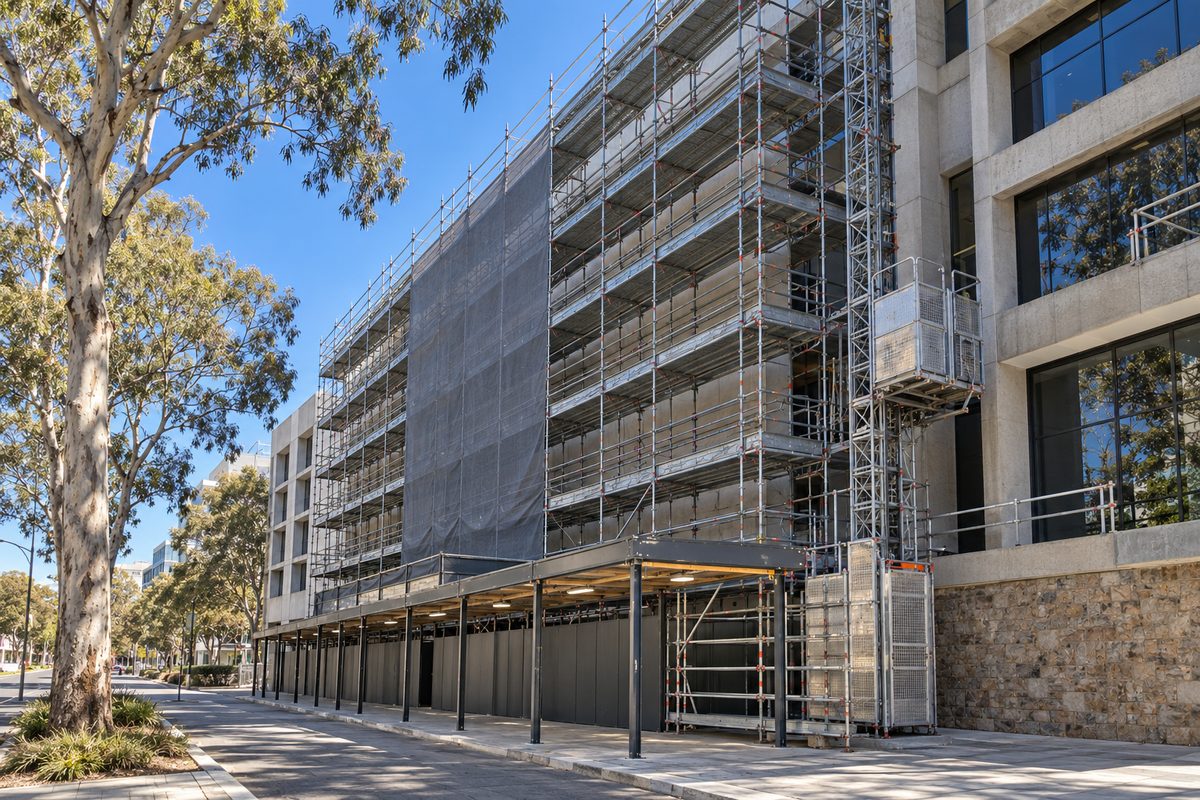
Facade work from a tall scaffold has a second problem, which is the building. Ties need to be taken back to the structure at points the scaffolder and the building owner agree, and the glass, render or cladding must not be damaged. For a building under strata, the committee or manager will need to approve fixings and the dates. For a government or heritage building, the owner will need to approve them as well. Ask who signs off the tie points before the quote is accepted.
Shade mesh, sheeting and wind
Sheeting or mesh on a scaffold catches wind, and the wind load goes into the scaffold and its ties. Safe Work Australia's information sheet on tower and mobile scaffolds says that height is limited by the manufacturer's base ratio and reduced if the scaffold is sheeted or wind-exposed, and says never to move a mobile scaffold in windy conditions. That sheet is about towers, not facade scaffolds, so use it as a reminder rather than a rule for your building. Ask the scaffolder who has checked the sheeted design, and what the plan is if a storm is forecast. WorkSafe ACT alerts say a scaffold should be inspected after an event affecting stability such as a severe storm, so a storm should trigger an inspection before anyone steps back on it.
The Bureau of Meteorology's Canberra Airport record (2008 to 2026) gives a mean annual rainfall of 636.7 mm, with December the wettest month at 75.2 mm. We do not publish wind statistics for Canberra beyond the two airport station values in the climate record, so wind assumptions belong to the scaffolder's design, not to this page.
Duties, plans and handover
WorkSafe ACT says the WHS Act gives duties to designers, scaffolding contractors and workers carrying out scaffolding work, and to principal contractors for a construction project where the cost is $250,000 or more. Larger commercial jobs may cross that line. On such a project the principal contractor is a duty holder, and a body corporate or building manager should ask who that is. Safe Work Australia's inspection guide says a competent person must give written confirmation that construction is complete before a high-risk scaffold is used, and that a scaffold with a fall risk over 4 metres is inspected at least every 30 days.
Safe Work Australia's guide says a scaffolding plan should be prepared by a competent person for more complex scaffolds, kept at the workplace, and shown with a site layout plan and elevations and sections. That is guidance, not a verified ACT duty, but it is the sensible thing to ask for on a commercial job. Its example handover certificate lists the certificate number, the erector and client details, the drawings and intended use, the duty classification, the number of working decks, the top platform height, the bay types, the plant design registration number if applicable, a handover inspection statement with the inspector's name, signature, licence number, date and time, client acceptance, and an attached checklist. WorkSafe ACT names a written handover certificate for suspended scaffolds, and Safe Work Australia's guide gives the example above, so ask for one on any scaffold. The inspections and handover page goes into it.
Footpaths, hoardings and public land
A commercial scaffold on a street frontage often meets public land. In the ACT, the approval for works on or using public unleased land applies to works on or occupying unleased public land, with applications 14 working days before starting and a temporary traffic management plan possibly needed. The public unleased land permit covers activities that exclude the public, with a skip on a footpath as the listed example. Neither page names scaffolding or hoardings, so we cannot say what an ACT hoarding standard is, and we do not state one. Confirm with the Public Land Use Team (02 6205 8794). In Queanbeyan the consent for works on a footpath or road comes from the council under section 138 of the Roads Act 1993, and the border page explains how it differs.
Overhead lines matter on the street side. Evoenergy gives clearances for hoarded scaffold of 1.5 metres from low voltage and 2.0 metres from 11 kV to 22 kV lines horizontally, and 2.4 metres vertically, and says a safe work method statement is required. On a government or heritage building, check the ACT Heritage Register for the block, because the Heritage Council pages we read do not mention scaffolding, and ask before fixing anything to a registered place.
What a commercial page cannot do
It cannot design or approve a scaffold, and it cannot tell you what loads, ties, sheeting or hoists your building can take. It cannot say whether your project is over the $250,000 threshold, whether public land approval covers your hoarding, or whether your building is heritage listed. A competent person and the scaffolding contractor carry those decisions, not this page or us. Ask for the plan, the handover certificate, the licence classes and the inspection schedule in writing, and keep them with the building records.
Check the current rules before you rely on this
This page describes how commercial scaffolding is licensed, inspected and approved for Canberra buildings. It describes the rules in general terms as they stood in October 2026. Standards, forms, thresholds and fines change.
The authoritative sources are Safe Work Australia, guide to scaffold inspection and maintenance, Safe Work Australia, guide to scaffolds and scaffolding work, WorkSafe ACT, scaffolding, SafeWork NSW, scaffolding licences, ABLIS, approval for works on or using public unleased land (ACT) and Evoenergy, scaffolding near overhead powerlines. Where anything here differs from those sources, they are right and we are not.
We are not scaffolders, engineers, regulators or lawyers. For what applies to your job, ask the scaffolding contractor, WorkSafe ACT (13 22 81) or, for work on public land, the ACT Government Public Land Use Team.
Accurate at the time of writing, October 2026. Always check the source before relying on it.