Two products for work at the edge of a roof and under four metres
Not every job at height needs a full perimeter scaffold. Two lighter products cover a lot of Canberra work. Roof edge protection is a barrier fitted along the edge of a roof, usually at the eave or gutter line, so that a person working on the roof cannot fall off the edge. A mobile scaffold is a tower on wheels that a painter, an electrician or a maintenance crew can roll to where the work is, and then lock in place. Both are also easy to get wrong, because they look simple.
The licence position is the reason many owners ask about them. Safe Work Australia's general guide says a licence is not required where the fall risk is 4 metres or less, and its example is a small frame scaffold for repairing eaves or painting a ceiling. That is why under-4-metre work often needs no high risk work licence. It is not a free pass, and the end of this page covers where it stops. We are a referral service: we pass your enquiry to local licensed scaffolders and do not own scaffolds or do the work.
What roof edge protection is
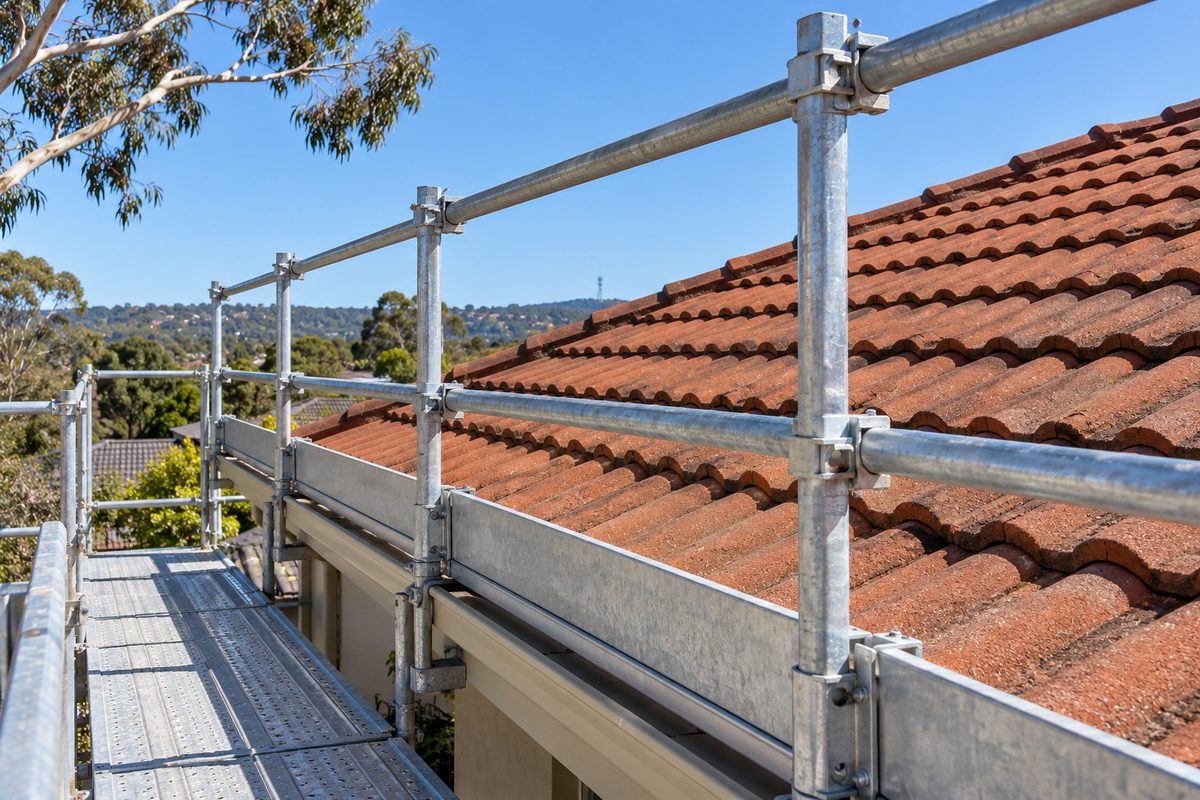
Edge protection for roof work is a set of posts clamped or fixed along the eave, with a guardrail along the top and a mid-rail below it. Often the same system carries a platform below the roof edge, where roofers stack tiles or sheets and step on and off. In re-roofing it is typically in place before the roofers start. The scaffolder decides how it is fixed.
WorkSafe ACT's scaffolding page says working decks need guardrails, mid-rails and toe boards, and that people on site need adequate instruction, training and supervision during erection, use and dismantling. Those are scaffold rules, but they describe what edge protection is for. A roofer working at the edge of a roof is the clearest example of a fall that a barrier prevents, and a ladder alone does not do it.
When edge protection is a separate job
On a full scaffold, the edge protection is part of the perimeter. On a roof job where the walls do not need work, only the roof does, a lighter system can be supplied on its own. Ask the scaffolder whether the edge protection is fixed to a scaffold, to the roof structure, or to a freestanding frame, because the answer decides who builds it and who must be licensed. The residential scaffolding page explains the house version, where a perimeter scaffold and edge protection are often built together. For a roof job, check that the quote says who supplies the edge protection, who erects and dismantles it, and who inspects it before the roofers start.
Because the edge is where the fall happens, the inspection matters as much as the build. WorkSafe ACT alerts say a scaffold should be inspected before first use, after events such as a severe storm, after repairs and at intervals not exceeding 30 days, by a competent person. Ask whether the same applies to the edge protection on your job, and who will check it after wind or rain.
What a mobile scaffold is, and when it is enough
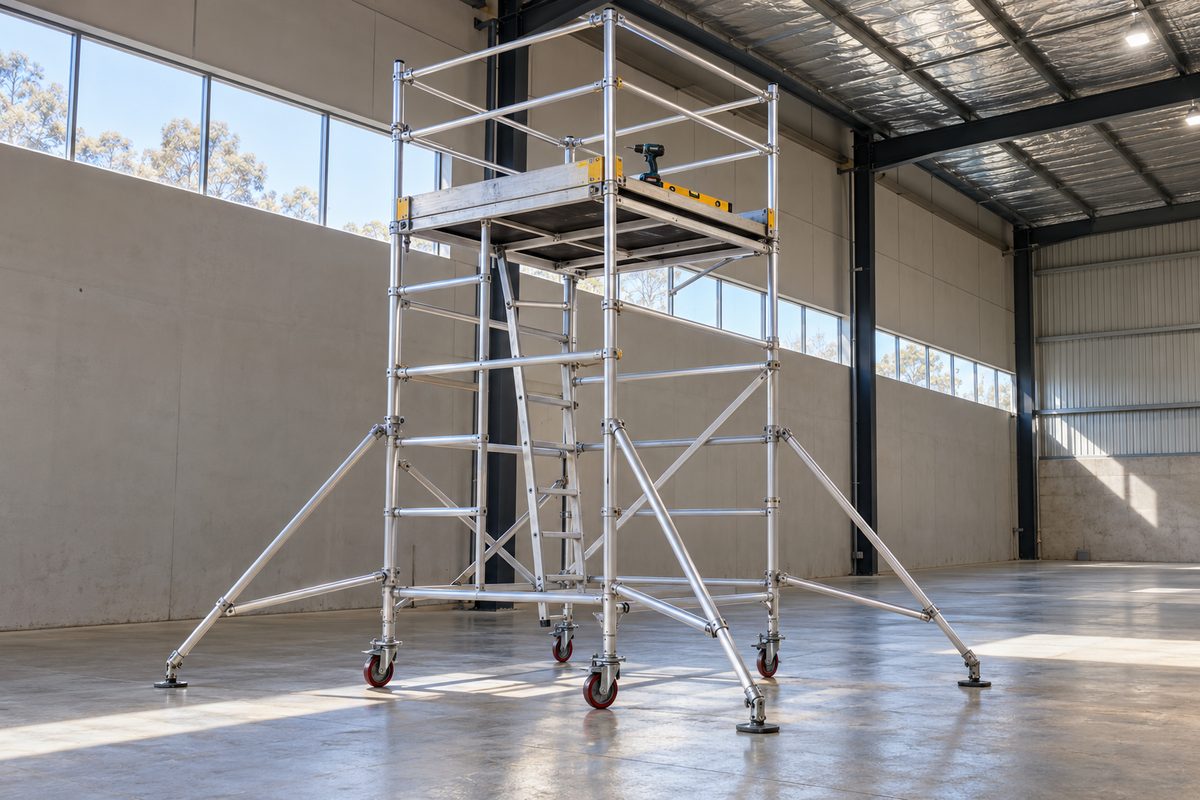
Safe Work Australia defines a mobile scaffold as "a tower scaffold mounted on wheels". The tower is built from aluminium or steel frames, with a working platform near the top, a guardrail around it and an internal ladder or stair to climb. Because it rolls, it suits work that moves along a wall or around a room: painting, ceiling work, light fittings, gutters on a single storey house, signs, and maintenance in a warehouse or workshop. Hire terms vary by contractor, so ask what the hire covers, whether it is delivered and who checks the tower.
A mobile tower is often enough for a single storey house, a shed, a garage or a shopfront, when the work is limited to a short run. A long wall, a two storey elevation or a re-roof may need a perimeter scaffold instead, and the scaffolder decides. The scaffolding hire page explains how a full scaffold hire runs.
| Check | What the guidance says | What to ask |
|---|---|---|
| Wheels | Wheels with a marked working load limit; locked whenever the tower is stationary | That every wheel locks, and the load limit is stamped |
| Moving it | Nobody on the tower when it is moved; never move in windy conditions | Who moves it, and the plan for a windy day |
| Ground | Adjustable wheels need a slope no more than 5 degrees | The slope of the floor or path; ask before you assume |
| Height | Limited by the manufacturer's base ratio, and reduced if sheeted or wind-exposed | The maximum platform height for the tower and the base width |
| Power lines | Check for overhead lines before moving | Where the lines are, and how far the tower can reach |
| Stability | Follow the manufacturer's instructions on bracing and any outriggers or stabilisers | Whether this tower needs outriggers on your floor |
The first five rows come from the Safe Work Australia information sheet on tower and mobile scaffolds and the WorkSafe ACT alerts. The last row is general: the manufacturer's instructions say whether outriggers or stabilisers are needed for a particular tower, and they are not a place to improvise.
Power lines, wind and floors
An aluminium or steel tower is metallic, so Evoenergy's guidance on scaffolding near overhead powerlines applies: keep 4 metres from overhead lines for metallic scaffold, and contact Evoenergy before work starts if that distance cannot be kept. Inside it the erector has to be Evoenergy-accredited. WorkSafe ACT's own scaffolding page gives a lower-level rule of 4 metres for metal and 1.5 metres for timber, and Evoenergy is the source for network clearances. Treat all lines as energised. Because a tower can be pushed along a wall, check the overhead route before every move, not only at setup.
Wind is the other reason towers tip. Safe Work Australia says never to move a mobile scaffold in windy conditions, and it reduces the permitted height of a tower that is sheeted or exposed to wind. We do not give wind statistics for Canberra beyond the Bureau of Meteorology's Canberra Airport station records, which are not specific to your site, so make the call on the day, not from a table. A tower inside a warehouse, on a flat concrete floor, out of the wind, is the easiest case. A tower on a lawn or a sloping driveway is the hardest.
Under 4 metres: what that does and does not mean
The 4 metre line is where the high risk work licence begins. WorkSafe ACT says scaffolding over 4 metres may be erected, altered or dismantled only by a licensed, competent person, and the model WHS regulation defines scaffolding work as work from which a person or object could fall more than 4 metres from the platform or the structure. Below it, a licence is generally not required, according to Safe Work Australia. That is why some mobile tower and low edge protection jobs may not need a high risk work licence, though the scaffolder decides.
It does not mean the scaffold has no rules. A scaffold under 4 metres can still need a licensed scaffolder if another fall hazard exists, such as beside an excavation, according to Safe Work Australia's tower sheet. Falls from height are notifiable incidents in the ACT even without injury, reported to WorkSafe ACT on 13 22 81 in business hours. Trades working from the scaffold need a safe work method statement, and incomplete scaffolds must be signed. Trestle scaffolds generally do not require a licensed scaffolder. The licence guide goes through the 4 metre line in plain terms, and the erection and dismantling page explains who is licensed to build the taller ones.
What this page cannot do
It cannot tell you whether your job is under 4 metres, because the fall is measured from the platform or the structure and depends on where the work is. It cannot say whether a particular tower is rated for your floor or your height, and it does not replace the manufacturer's instructions or the hire business's briefing. It does not cover outriggers for every tower. Ask the scaffolder for the platform height, the base width, the wheel load rating and whether outriggers are needed, and ask who inspects the tower or edge protection while it is on site.
Check the current rules before you rely on this
This page describes roof edge protection and mobile scaffold towers and how the 4 metre licence line applies to them. It describes the rules in general terms as they stood in October 2026. Standards, forms, thresholds and fines change.
The authoritative sources are Safe Work Australia, tower and mobile scaffolds information sheet, Safe Work Australia, guide to scaffolds and scaffolding work, WorkSafe ACT, scaffolding, WorkSafe ACT, stay safe on scaffold, Evoenergy, scaffolding near overhead powerlines and Work Health and Safety Regulations (Commonwealth compilation), definition of scaffolding work. Where anything here differs from those sources, they are right and we are not.
We are not scaffolders, engineers, regulators or lawyers. For what applies to your job, ask the scaffolding contractor, WorkSafe ACT (13 22 81) or, for work on public land, the ACT Government Public Land Use Team.
Accurate at the time of writing, October 2026. Always check the source before relying on it.