Three places, one page
North Canberra, South Canberra and Queanbeyan are grouped here because they share a handful of questions that the outer districts do not. North and South Canberra have the highest higher density shares among the ACT districts. Queanbeyan is in NSW, with its own council and its own regulator. A scaffold job in any of them can turn on heritage, on height or on which side of the border the site is, and a scaffolder who works in all three needs to know the rules of both jurisdictions. So does the person who is hiring one.
North and South Canberra: the densest districts
ACT Planning's district profiles, tabulated on the Gungahlin profile page, give South Canberra a higher density share of 45 per cent and North Canberra 41 per cent, the two highest of the districts. They also show North and South Canberra with the lowest number of people per household, 2.2, against 2.9 in Gungahlin. The dwelling mix is undated, so these are shapes rather than counts. We did not verify the population of either district, and we have no verified information about specific streets or buildings, so this page does not describe any.
What the numbers suggest is a different job mix from the outer districts. With four in ten dwellings or more in higher density buildings, the scaffold work is more likely to involve apartment buildings, with a building manager or body corporate, a taller structure, and a footpath beside it that people use. The ABS snapshot of the ACT in 2021 shows flats and apartments rising from 15.0 per cent to 19.4 per cent of dwellings across the territory in five years, which is consistent with a continuing shift to higher density, though it is a territory figure and not an inner-district one.
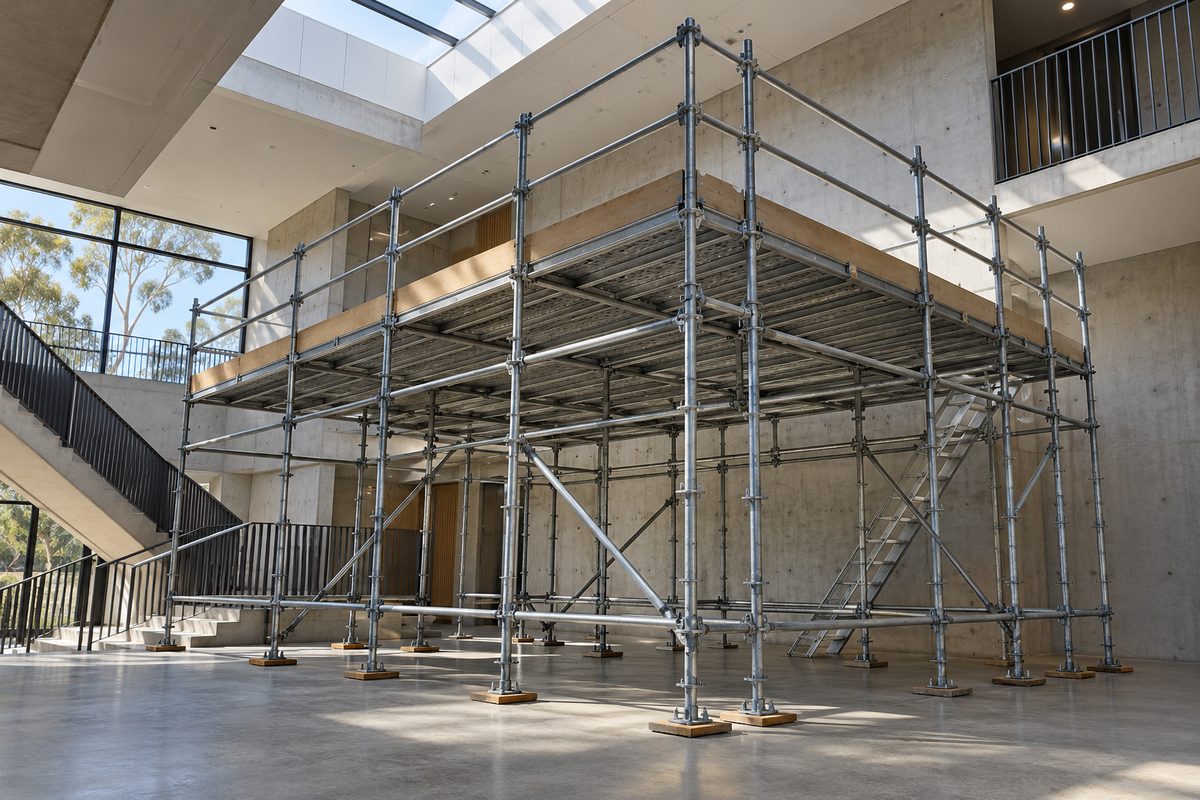
Taller buildings and the questions they raise
The licence rule is the same as elsewhere in the ACT: a high risk work licence for erecting, altering or dismantling a scaffold from which a person or object could fall more than 4 metres. Access Canberra lists Basic (SB), Intermediate (SI) and Advanced (SA) classes. Higher density buildings are more likely to cross that line, and some of the work will be inside, as with the birdcage in the photo above. Safe Work Australia defines a birdcage as an independent scaffold with more than two rows of standards in both directions, and the types guide describes the others.
A complex scaffold is also the case where Safe Work Australia says a plan should be prepared by a competent person, and where a handover certificate is most useful. Ask whether there is a plan, who prepared it and who holds the copy. The commercial page explains covered walkways, hoists and gantries, and the footpath guide covers the public land approval process for the pavement outside.
Heritage: check before you fix anything
Heritage is worth a check here. The ACT Heritage Council acts under the Heritage Act 2004 to ensure that changes to heritage places do not reduce their heritage significance. The Government's page on development at heritage sites lists the work that needs consideration, including building additions and alterations, earthworks and removing mature plants, and describes two pathways: a development application to the Territory Planning Authority, or exempt development with the Heritage Council's agreement. The page does not mention scaffolding or temporary works. We therefore do not say that scaffolding is exempt, and we do not say that it is controlled either. We do not know.
What you can do is look. The heritage status page on the ACT Planning site explains how to check a block, using the ACT Heritage Register and the heritage map on ACTmapi, and gives [email protected] for questions. The register itself shows entries with a status of Registered, Provisionally registered, Nominated or Rejected, and [email protected] can confirm a status. Planning also notes that to be exempt from a development application, a project must not breach the Heritage Act 2004. If your block is on the register, ask before fixing anything to the place, since a scaffold that ties into a wall, a roof or a chimney fixes to the building. The Heritage Advisory Service is on 02 6295 3311.
Queanbeyan: a different jurisdiction, the same classes
Queanbeyan is in Queanbeyan-Palerang Regional Council, in New South Wales. The ABS 2021 census figures for the area on the QuickStats page are 63,304 people, a median age of 38, 26,503 private dwellings and 73.9 per cent separate houses. Separate houses at 73.9 per cent is higher than the ACT figure of 63.2 per cent, so the house-scale points on our Tuggeranong page may apply to some Queanbeyan work. These are figures for the whole council area, not for the town alone.
The licensing rule is the same on both sides of the border. SafeWork NSW (13 10 50) uses the same class names, Basic (SB), Intermediate (SI) and Advanced (SA), and defines scaffolding work as erecting, altering or dismantling a temporary structure from which a person or object could fall more than 4 metres from the platform or the structure. What changes is the regulator and the local authority. In Queanbeyan the regulator is SafeWork NSW, where the ACT has WorkSafe ACT (13 22 81) for safety and Access Canberra for licences.
Licences across the border
Access Canberra says a high risk work licence issued by another state or territory will be recognised in the ACT. SafeWork NSW says valid interstate licences are recognised in NSW, that employers must see the licence before high risk work starts, and that licences can be checked through Service NSW or the issuing authority. Safe Work Australia says a high risk work licence is generally valid across Australia, but to check with the regulator where you will work. The practical result is that an ACT-licensed scaffolder can work in Queanbeyan and a NSW-licensed one in Canberra on the same class of work. Cross-border work is possible on these terms, so a business based on one side may be the one that quotes you on the other, and you should ask for the licence number and check it with the issuing authority, since most local scaffolders do not publish it. The border page goes into the detail.
Footpaths and nature strips in Queanbeyan
In Queanbeyan the public land question is a NSW one. The NSW Planning Portal explains that consent under section 138 of the Roads Act 1993 covers works on a footpath, nature strip or verge and erecting, removing or interfering with a structure on a public road, and that the local council is usually the authority. We did not find a Queanbeyan-Palerang Regional Council approval for scaffolding or hoardings. The council has an approval to swing or hoist an item on or near a public road, but that page does not mention scaffolding or hoardings, so do not assume it applies. Ask the council which approval, if any, fits your scaffold on the street. In the ACT, by contrast, the process found is the Public Unleased Land Act 2013 and the Public Land Use Team. See also the footpath guide.
Winter and getting a quote
All three places share Canberra's climate record as the nearest we have: a mean minimum of 0.1 degrees Celsius in July at Canberra Airport, and frost risk that has typically ended by the last week of October. Short, frosty days slow the trades and can lengthen a hire, so read the hire length guide. When you ask for a quote, state which side of the border the site is on, how high the work is, whether the building is on a heritage register, and whether the scaffold will sit over a footpath. Local scaffolders are concentrated in Hume, Fyshwick and Queanbeyan, so a job in these places is among the closest to where they are based, though that does not make a quote cheaper.
What this page cannot settle
It cannot tell you whether a scaffold on a heritage-registered place needs approval, because the pages we read do not mention scaffolding. It cannot say what Queanbeyan-Palerang Regional Council requires for a scaffold on a public road, because we did not find its approval. It does not describe any particular street or building. It also cannot confirm that your scaffolder is licensed in the right class. Check the Heritage Register, ask the council and the Public Land Use Team, and check the licence with Access Canberra or SafeWork NSW.
Check the current rules before you rely on this
This page describes inner Canberra and Queanbeyan, the heritage register check and the NSW and ACT rules that apply to scaffolding on either side of the border. It describes the rules in general terms as they stood in October 2026. Standards, forms, thresholds and fines change.
The authoritative sources are ACT Planning, Gungahlin district profile, ACT Government, development at heritage sites, ACT Government, ACT Heritage Register, ABS 2021 Census QuickStats, Queanbeyan-Palerang, SafeWork NSW, scaffolding licences and NSW Planning Portal, section 138 approvals. Where anything here differs from those sources, they are right and we are not.
We are not scaffolders, engineers, regulators or lawyers. For what applies to your job, ask the scaffolding contractor, WorkSafe ACT (13 22 81) or, for work on public land, the ACT Government Public Land Use Team.
Accurate at the time of writing, October 2026. Always check the source before relying on it.