Why a scaffold is checked twice before you use it
A scaffold is not finished when the last bay is built. It is finished when somebody competent has looked at it as a whole, confirmed that it was built as intended and that it is safe to stand on, and said so. After that it has to be looked at again at intervals, and after anything that could have changed it. Both ideas run through the guidance from WorkSafe ACT and from Safe Work Australia's guide to scaffold inspection and maintenance, and both matter more than most people expect, because a scaffold is a temporary structure that stands outdoors for weeks while trades move and load it.
If you are the home owner or the builder, you are probably not the person who inspects it. But you are the person who can ask to see the evidence that it was done. This page explains what to look for. It also separates what the ACT sources we read say outright from what is guidance or an example, because the difference matters if something goes wrong or a trade asks you what you were given.
The 30 day inspection and the scaffold tag
WorkSafe ACT's alerts on scaffolding say a scaffold should be inspected before first use, after events that could affect stability such as a severe storm, before use after repairs, and at intervals not exceeding 30 days, by a competent person. If a flaw is found it must be repaired and the scaffold inspected again by a competent person before anyone uses it further. Safe Work Australia's guide says the same for scaffolds from which the fall could be more than 4 metres, with at least a 30 day interval, and says a scaffold with a fall risk under 4 metres is inspected before use and after incidents, repairs or alterations.
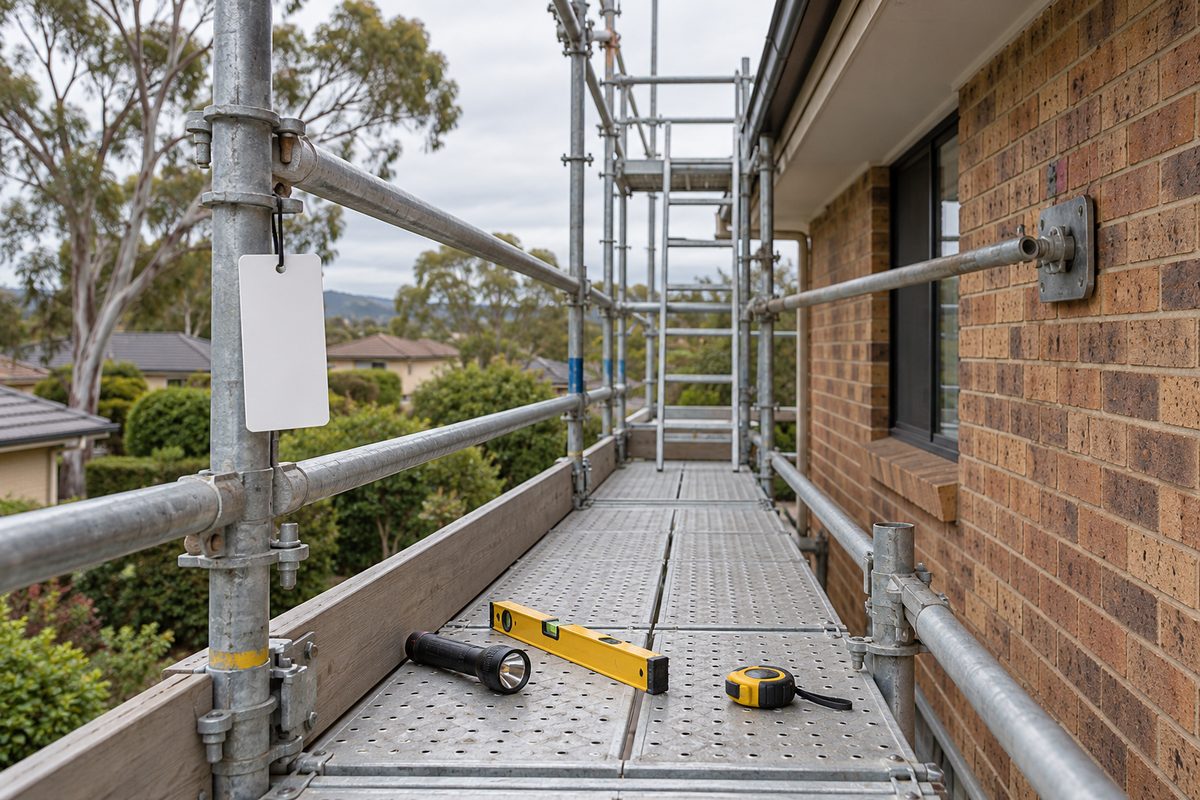
The visible sign of this is the tag. WorkSafe ACT's stay safe on scaffold page lists, among the problems found on sites, a scaffolding tag that has not been inspected by a correctly licensed person within a 30 day timeframe, and no scaffolding tag in place at all. Put simply, a tag on the scaffold with a recent inspection date is what to look for. A blank tag, a tag with an old date or no tag is a reason to stop and ask.
What a handover inspection covers
Safe Work Australia's guide says that a competent person must give written confirmation that construction is complete before a high risk scaffold is used. In plain terms, a high risk scaffold is one from which a person or object could fall more than 4 metres. The handover is that moment of confirmation. The exact checklist belongs to the scaffolder, but the photo above gives the idea of what may be looked at: the base is sound and sits on sole boards or other adequate support, the standards are plumb, the ledgers and bracing are in place, the ties are fixed to the building, the decks are complete with guardrails, mid-rails and toe boards, and the access is safe. Incomplete parts are signed. WorkSafe ACT's alert says an unfinished scaffold must carry a sign saying it is incomplete and not to be used.
The same guide says the person who has management or control of a scaffold must make sure it is inspected and maintained at handover, after handover, and after repairs, modifications or additions. That may be the scaffolding contractor, the builder or the owner, and on a larger site the principal contractor may be involved. If you are a builder hiring a scaffold for your own crew, you should know who that is on your project, and the answer should be in writing.
What an example handover certificate contains
Safe Work Australia's guide includes an example handover certificate in its Appendix B. It is an example, not a form the ACT requires you to use, but it is a good measure of what a thorough certificate shows. The contents are:
| Item on the example certificate | What it tells you |
|---|---|
| Certificate number | A reference that links the certificate to this scaffold, so it can be found again. |
| Erector and client details | Who built it and who it was built for. |
| Drawings and intended use | What the scaffold was designed to do, such as access for painting or a load-carrying platform. |
| Duty classification | The load class the scaffold was built for. |
| Number of working decks | How many levels can be used at once. |
| Top platform height | How high the highest working deck is. |
| Bay types | The kinds of bay in the structure, including any special bays. |
| Plant design registration number | Where applicable, the registration that relates to the scaffold system. |
| Handover inspection statement | The inspector's name, signature, high risk work licence number, date and time. |
| Client acceptance | That the person receiving the scaffold has accepted it. |
| Inspection checklist | A checklist attached to the certificate. |
A small scaffold may come with less paperwork than a large one, but the list shows what to ask for. At the very least you want the erector's name, the date and time of the handover inspection, the inspector's name and licence number, and a statement that the scaffold is complete and safe to use.
What is and is not verified as an ACT requirement
This is the part to read carefully, because it is easy to overstate. Here is where our research stopped.
- Verified in ACT sources: inspection before first use, after a severe storm, after repairs and at intervals not exceeding 30 days by a competent person; a scaffold tag that has been inspected within 30 days; incomplete scaffolds signed; falls from height being notifiable to WorkSafe ACT. WorkSafe ACT also names a written handover certificate from the installer for suspended scaffolds.
- Not verified as a general ACT legal requirement: a handover certificate for every scaffold. The ACT pages we read do not mention one for ordinary scaffolds, and we could not read the ACT Work Health and Safety Regulation itself. Safe Work Australia's guide describes a handover inspection and an example certificate, and cites regulation 225 of the model regulations for the duty to inspect, but we have not confirmed the ACT text.
- Not verified as a general ACT legal requirement: a written scaffold plan. Safe Work Australia says that for more complex scaffolds a plan should be prepared by a competent person.
- Not verified from the regulation: the source of the 30 day interval, which the alerts and the Safe Work Australia guide state but which we have not read in the ACT regulation.
The practical answer is simple. Ask for a handover certificate on any scaffold, because the safe approach does not depend on whether a rule makes the scaffolder give you one. If the scaffolder says none is issued for a small job, ask for the handover inspection to be recorded on the tag and in writing by message or email. A scaffolder who inspects properly will have no objection.
Scaffold plans for complex scaffolds
Safe Work Australia's general guide says that for more complex scaffolds a scaffolding plan should be prepared by a competent person and kept at the workplace or readily accessible. It describes the plan as including a site layout plan and elevations and sections. This is guidance, and we are not able to say that the ACT makes it compulsory. It is still worth asking about when the scaffold is more than a simple frame along a wall.
What counts as complex is for the scaffolder and the engineer to judge, but things that may prompt the question include a structure that is unusually tall or wide, one that is covered in sheeting or hoarding so that it takes wind load, a birdcage over a large floor area, a hung or suspended scaffold, a cantilever, or a scaffold that carries heavy materials such as roof tiles or bricks. The types guide describes these. If your job is one of them, ask whether there is a plan, who prepared it and where a copy will be kept on site. For commercial and multi-storey work the commercial scaffolding page covers what building managers usually ask for.
After a storm, repairs or changes
The alerts name three events that call for a fresh inspection: a severe storm, repairs, and, in the Safe Work Australia guide, alterations or additions. If a trade asks the scaffolder to add a lift, remove a tie to get a ladder through or open a bay to pass materials, that is an alteration, and the scaffold should be checked before it is used again. Do not remove or loosen any part yourself, however small. If you are a builder, tell your people that the scaffold is not theirs to modify.
After a storm, do not climb it to look. Check from the ground for anything that has moved, sheeting that has torn, a tie that has pulled out or a component that has fallen, and call the scaffolder. Keep people off the scaffold until the inspection has been done and the tag updated. Falls from height are notifiable to WorkSafe ACT immediately, and the 2023 alert gives 13 22 81 in business hours and 0419 120 028 after hours; but reporting is for when something has gone wrong, and an inspection is how you avoid it.
What to ask to see on the day
When the scaffolder tells you the scaffold is ready, take five minutes. Ask who carried out the handover inspection and to see their name and licence number on the certificate or tag. Look for the tag at the access point and read the date. Check that the guardrails, mid-rails and toe boards are on every working deck, that the access ladder is secured, and that any incomplete part is signed. Ask when the next 30 day inspection falls due and who will do it. If the scaffold is close to power lines or on a nature strip, ask whether that was part of the inspection; the footpath guide covers the permissions. And confirm that the erector holds the right class of licence, which the licence guide explains.
What an inspection page cannot do
It cannot inspect your scaffold. It cannot tell you whether a particular tag, certificate or plan meets the ACT regulation, because we could not read the ACT regulation and have set out above what we could and could not confirm. It cannot replace the judgement of a competent person on site, and it should not be used to decide that a scaffold is safe to climb. If anything about the scaffold looks wrong, stay off it and call the scaffolder. For questions about duties and notices, ask WorkSafe ACT on 13 22 81.
Check the current rules before you rely on this
This page describes scaffold inspections, tags and handover certificates, and the limits of what we could verify about ACT requirements. It describes the rules in general terms as they stood in October 2026. Standards, forms, thresholds and fines change.
The authoritative sources are WorkSafe ACT, scaffolding falls from height alert, WorkSafe ACT, scaffolding safety alert, WorkSafe ACT, stay safe on scaffold, Safe Work Australia, guide to scaffold inspection and maintenance, Safe Work Australia, scaffolding duties tool and WorkSafe ACT, scaffolding. Where anything here differs from those sources, they are right and we are not.
We are not scaffolders, engineers, regulators or lawyers. For what applies to your job, ask the scaffolding contractor, WorkSafe ACT (13 22 81) or, for work on public land, the ACT Government Public Land Use Team.
Accurate at the time of writing, October 2026. Always check the source before relying on it.