The names come from Safe Work Australia
Scaffolders and builders use a lot of trade names, and the names are not always the same from one business to the next. The most useful common vocabulary is the one in Safe Work Australia's guide to scaffolds and scaffolding work, which defines the types by how they are built and what they hold up. This page follows that guide. It sorts the kinds into tube and coupler, prefabricated, birdcage, trestle, hung, single pole, suspended or swing stage, tower and mobile, and special duty. It then says which types suit which jobs, in general terms, and what the regulators say about the licence class for each.
Two cautions before the list. The scaffolder chooses the type for your job, and an engineer may need to design it, so this page helps you ask better questions rather than pick for yourself. And the guide is a national one, so it uses terms that a Canberra operator may express differently on a quote. If a quote uses a word that is not on this page, ask what it means.
Tube and coupler
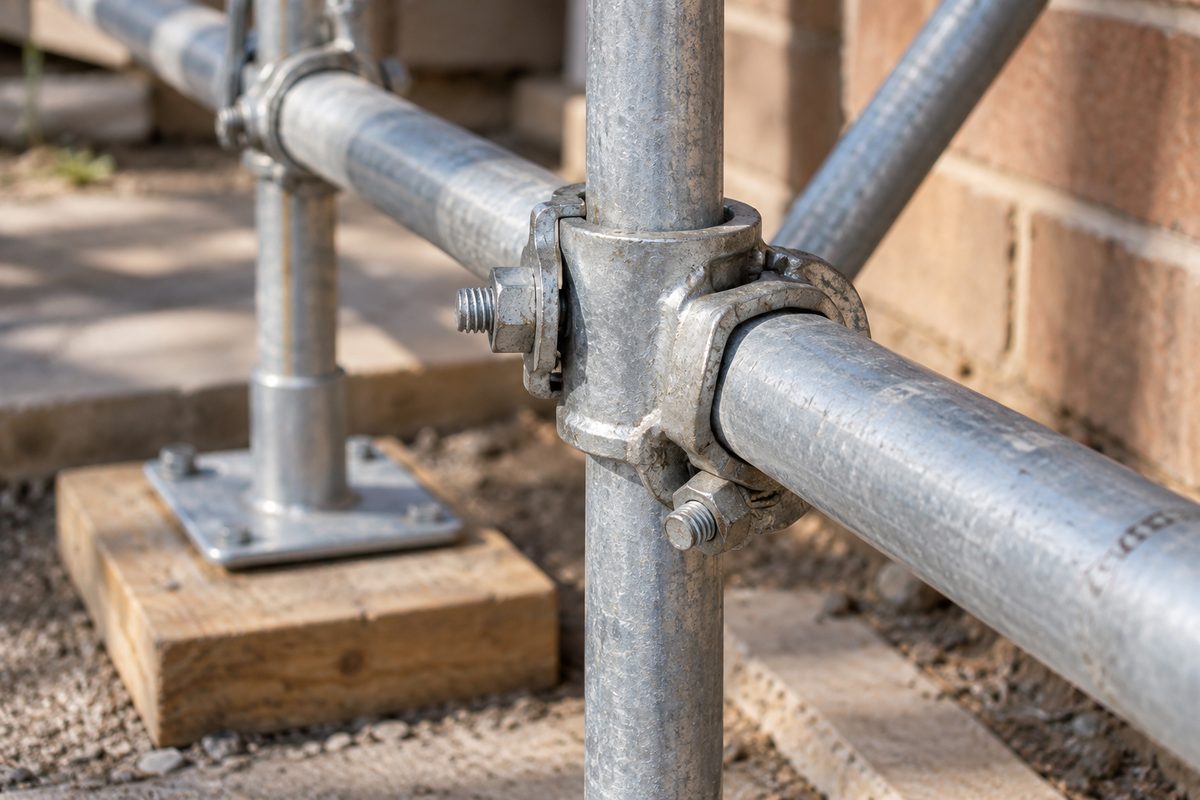
The guide describes a tube and coupler scaffold as one built from tubing and joining or fixing components, called couplers. Round steel tubes are clamped together with couplers, standing on base plates that sit on timber sole boards. Because it is built from separate tubes and couplers, it can be shaped to suit awkward buildings.
Because it is built piece by piece, it may take longer to erect than a prefabricated system, and it may be chosen when the building does not suit a repeating modular layout. The scaffolder decides. On the licence side, the NSW regulator's description of the scaffolding classes puts tube and coupler scaffolds in the intermediate class, covered below.
Prefabricated, including modular
The guide defines a prefabricated scaffold as an integrated system of prefabricated components. It lists modular, tower, cantilever, hung and suspended among the kinds that can be built from prefabricated parts. Modular is what most people picture on a house: standards with fixed connection points, ledgers that lock into them, steel decks and guardrail posts that fit the system. Modular steel is often called Kwikstage, a brand name, and you may see that word on a quote. The Safe Work Australia guide does not treat modular as a separate type; it sits under prefabricated.
Modular parts fit together in a known pattern. Where a building has an unusual shape, the scaffolder may combine modular with tube and coupler. The NSW regulator's page places modular and prefabricated scaffolds in the basic class, which is the starting point of the three.
Birdcage
The guide defines a birdcage as an independent scaffold with more than two rows of standards in both directions. Think of a forest of posts supporting one large working deck at the top. It is used where the work is overhead across a floor area, rather than along a wall: a ceiling in a large room, an atrium, a stairwell, a plant room. The rows of posts spread the load, and the working deck at the top can carry people and materials across a wide area.
A birdcage may be a case where a scaffold plan or an engineer's design is worth asking about. It is a reason to ask about the plan, which the inspections guide explains.
Trestle, hung, single pole and swing stage
These are the types you will see less often on a home job, and several are specialist.
- Trestle. A platform supported on trestle frames. The guide says trestle scaffolds generally do not require a licensed scaffolder. The height and the fall risk still matter, so ask the scaffolder to measure it.
- Hung. The guide describes a hung scaffold as an independent scaffold that hangs from another structure but is not capable of being raised or lowered. It is a specialist type, used where building up from the ground is not practical. The NSW regulator's page places hung scaffolds in the advanced class.
- Single pole. The guide lists it as its own type. It is uncommon on a home job, so if a quote uses the term, ask the scaffolder to explain how it will be supported and what it relies on.
- Suspended or swing stage. A suspended platform, which unlike a hung scaffold can be raised and lowered, and which suits work on tall faces. WorkSafe ACT says an advanced scaffolding licence holder may install and dismantle suspended scaffolds, and it names a written handover certificate from the installer for them.
Tower, mobile and special duty
The guide says a mobile scaffold is a tower scaffold mounted on wheels. This is the aluminium tower on castors that you might hire for a fixed internal job, for example in a warehouse, a stairwell or a hall. The Safe Work Australia tower and mobile sheet gives the practices that matter: wheels with a marked working load limit, wheels locked when the tower is stationary, no person on the tower when it is moved, no moving it in windy conditions, a check for overhead power lines before moving, and a height limit set by the manufacturer's base ratio that is reduced if the tower is sheeted or exposed to wind. It also says a slope over 5 degrees is a limit for towers on adjustable wheels. WorkSafe ACT adds that wheels should be locked and nobody on the tower when it is moved. The sheet makes a further point worth remembering: a scaffold under 4 metres can still need a licensed scaffolder if there is another fall hazard, such as beside an excavation. The mobile scaffold page covers hire for these.
The guide's last group is special duty, which includes cantilever, hanging bracket and spur scaffolds. These carry unusual loads or are supported in unusual ways, such as projecting out from a building where the ground cannot take a standard. They are specialist, they may need design, and they are not something to specify yourself.
Which type suits which job
The table gives a general match. The scaffolder decides, and a different building can lead to a different answer.
| Job | Type that often suits it | Notes |
|---|---|---|
| Painting or re-roofing a house | Modular (prefabricated) | Often suits straight walls on houses. Edge protection at the gutter is a separate point. |
| Building with curves, projections or awkward corners | Tube and coupler | Joints are made by hand so it fits the shape. Takes longer to build. |
| Overhead work across a large floor area | Birdcage | More than two rows of standards each way and a full deck at the top. Often needs a plan. |
| Low interior work, such as a ceiling | Trestle or a mobile tower | Trestle scaffolds generally do not need a licensed scaffolder. Check the fall height. |
| Fixed internal job in a large room | Mobile tower | Wheels locked when in use and nobody on it when moved. |
| Facade work on a tall building | Prefabricated or suspended | Suspended work belongs to the advanced licence class. |
| Where the ground cannot support a scaffold | Hung or special duty | Specialist work. Ask the scaffolder what is proposed and which licence class applies. |
Licence classes as the regulators describe them
The ACT has three classes of scaffolding licence: Basic (SB), Intermediate (SI) and Advanced (SA), with Access Canberra as the licensing authority. No ACT page we read lists what each class covers. SafeWork NSW's page and another state regulator's page do, and the national class codes are the same, so we give the scopes as those regulators describe them.
- Basic (SB): modular and prefabricated scaffolds, cantilevered materials hoists up to 500 kg, and bracket scaffolds.
- Intermediate (SI): adds tube and coupler scaffolds, including covered ways and gantries, cantilevered and spurred scaffolds, perimeter safety screens and shutters, and mast climbers.
- Advanced (SA): adds cantilevered hoists, hung scaffolds and suspended scaffolds.
Another state regulator states that intermediate requires basic and advanced requires basic and intermediate, so the classes are described as building on each other. All of this applies to scaffolding work where a person or object could fall more than 4 metres from the platform or the structure. Below that a licence is generally not required, but the licence guide explains the exceptions in plain language, and the regulator page has the class names and contacts. If your quote involves a type in the intermediate or advanced list, ask which class the erector holds, and ask for the licence number so you can check it. For Queanbeyan, SafeWork NSW applies the same class names; see the border page.
Whatever the type, the standard that applies is AS 1576. WorkSafe ACT says scaffolding must meet it, and Safe Work Australia's guides refer to the AS 1576 series, with AS 1577 for decking components and AS/NZS 4576 as guidelines. Which edition applies is a question for the scaffolder.
What a list of types cannot decide
It cannot choose the right scaffold for your building. That depends on height, shape, ground, loads, access, nearby power lines and what the trades need to carry. It cannot tell you that a licence is not needed for your job, because the 4 metre line depends on where a person could fall from, and the scaffolder measures that. It also cannot confirm the scope of each licence class under ACT rules, since the scopes here come from NSW and another state regulator. Ask the scaffolder which type they propose, why, and which class of licence the erector holds.
Check the current rules before you rely on this
This page describes the scaffold types defined by Safe Work Australia and the licence class scopes as the NSW regulator and a second state regulator describe them. It describes the rules in general terms as they stood in October 2026. Standards, forms, thresholds and fines change.
The authoritative sources are Safe Work Australia, guide to scaffolds and scaffolding work, Safe Work Australia, tower and mobile scaffolds information sheet, SafeWork NSW, scaffolding licences, WorkSafe Queensland, scaffolder licences, Access Canberra, high risk work licences and ABLIS, AS/NZS 1576 scaffolding. Where anything here differs from those sources, they are right and we are not.
We are not scaffolders, engineers, regulators or lawyers. For what applies to your job, ask the scaffolding contractor, WorkSafe ACT (13 22 81) or, for work on public land, the ACT Government Public Land Use Team.
Accurate at the time of writing, October 2026. Always check the source before relying on it.